


Central African Republic
Forest resources and context of Central African Republic
Update in progress
44.6% of CAR's total area of dense humid forests are used for production purposes.

Land surface
62.3million ha
Forest cover
22.2million ha
Production forest
4.8million ha
Forest ownership
98.9% publicly
Forest lost
xxx
ha/year
cONTEXT
Types of forest
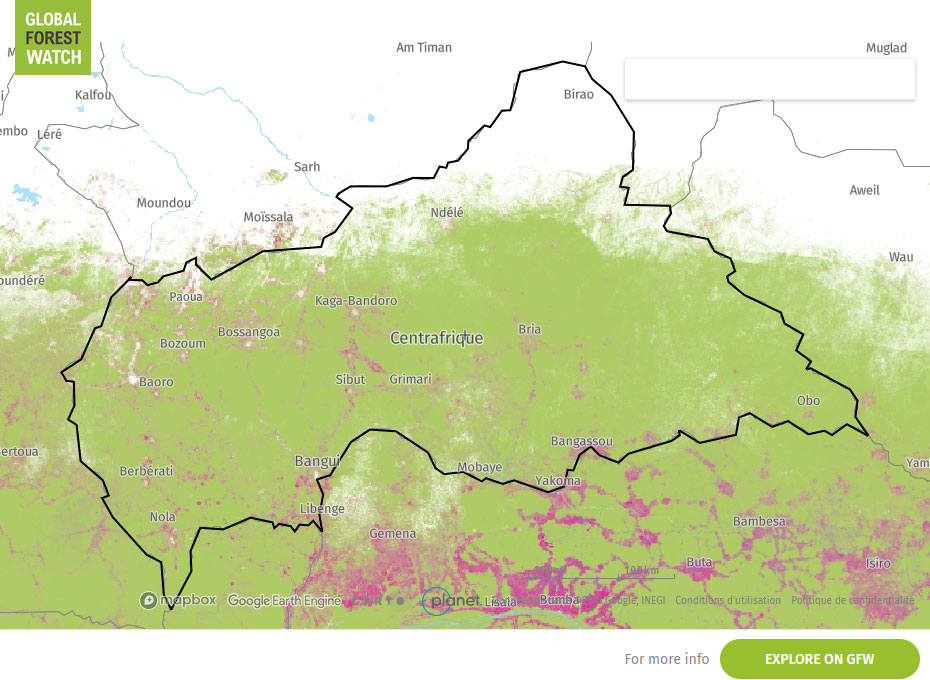
The forests of the Central African Republic (CAR) can be distinguished in the dense humid rainforest in the south and north of these forests a dryer transition zone between forest and savannah. About 90% of the nation is covered with more or less dense wooded and shrubby savannas. The dense humid rainforests of the south-west and, to a lesser extent, the Bangassou region, which are mainly semi-deciduous, cover over 3 million hectares and only 5.5% of the nation. The forest production areas are exclusively located in the south-west's dense forest massif. From an economic standpoint, this semi-deciduous forest is one of Africa's richest. In addition to a relatively high density of Sapelli (Entandrophragmacylindricum), and other Meliaceae, there are significant concentrations of Ayous (Triplochytonscleroxylon) and Fraké (Terminaliasuperba). (Dacryodesbuettneri);
Out of a national area covering 62.3 million ha, CAR has nearly 6.9 million hectares of dense forests. In relation to the Congo Basin's total forests, though, CAR accounts for only 3.71%.
In the Central African Republic, since 1996, armed movements have been located in the north of the country (Ouham-Pendé, Ouham and Vakaga prefectures), i.e. several hundred kilometres from the forest production region.
Forest ownership in Central African Republic
Almost the whole forest area (98.9%) belongs to the state.
The Central African forest law (2008) splits the national forest domain into two parts: the permanent forest domain (the south-west massif, the Bangassou massif and the savannas) and the non-permanent forest domain (public authorities' forest areas, private individuals' forests and community forests).
RISK SCORES
|
CORRUPTION PERCEPTION INDEX (Transparency international) Corruption Perception Index 26/100
0 is highly corrupt, 100 is very clean. |
ILLEGAL DEFORESTATION AND ASSOCIATED TRADE (IDAT) Risk (Forest Trend) /100 100 is higher risk, 0 is lower risk
|
|
SOURCING HUB RISK SCORE (Preferred by nature) /100 0 is higher risk, 100 is lower risk
|
COUNTRY DEFORESTESTATION CLASSIFICATION LIST - EUDR (European Commission) LOW risk category For more information about the methodology, see here
|
Sources:
Interpretation of Risk Indicators
Subnational variations in risks
| HARVESTING SOURCE | DUE DILIGENCE COMPLEXITY | DUE DILIGENCE CONSIDERATION |
|---|---|---|