


刚果民主共和国
刚果民主共和国的森林资源和背景
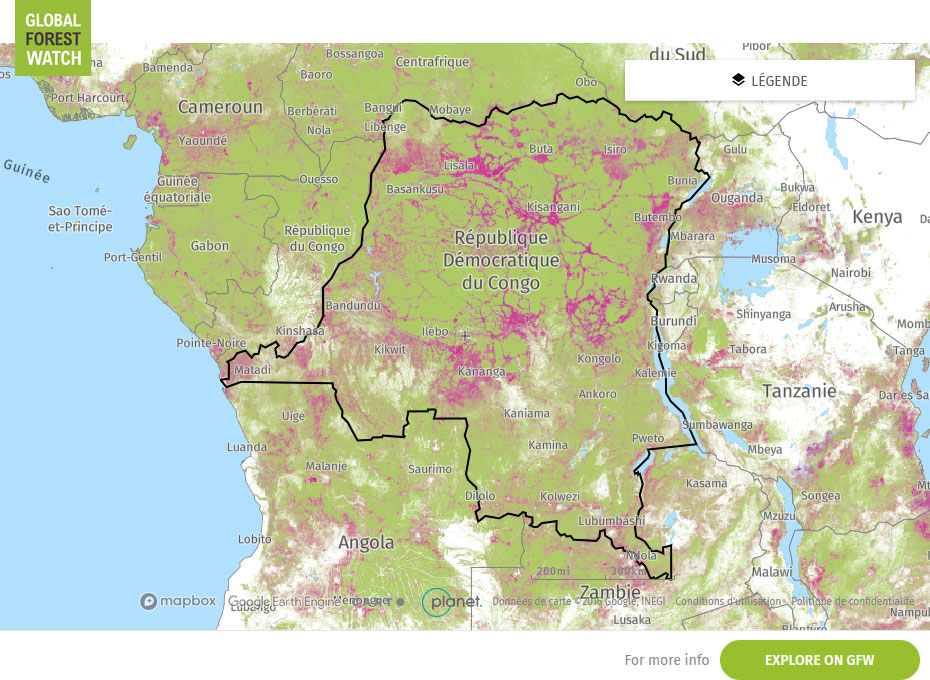
According to 根据 FRMi 2018 年进行的研究显示,刚果民主共和国 (DRC) 2017 年拥有约 1.145 亿公顷森林,占土地总面积的 49%。根据粮农组织 (FAO) 2020 年进行的另一项研究显示,该国森林面积为 1.26 亿公顷(包括退化森林)。

陆地面积
226.7百万公顷
森林覆盖
126百万公顷
生产林
19.7百万公顷
森林所有权
100% 公有
森林资源
森林类型
《刚果民主共和国森林法典》(2002 年)将森林分为三个类别:
- Forêts Classées(分类森林),例如自然保护区、动物保护区、游憩林和国家公园 — 公有林区:这种森林通常称为“保护区”,但不要与下一类“受保护森林”混淆。 这种森林由分类法定义,并根据其生态价值对用户权利和开采有司法限制。分类森林应至少占刚果民主共和国总领土面积的 15%。
- Forêts protégées(受保护森林)是指分类法未定义的森林,对于用户和开采权利的限制较少。受保护森林可以成为特许经营合同的一部分,期限不超过 25 年。另外,当当地社区对受保护森林拥有惯有权利时,可以获得对该森林部分或全部区域的特许权。(例如手工伐木许可证和采伐许可证)。
- Forêts de production permanente(永久性生产林)是指通过公开调查排除受保护森林的部分。此类森林的开采应符合《森林法典》的规定。森林特许经营区和当地的共有林均属于永久性生产林。
刚果民主共和国目前仅分配约 10% 的森林用于伐木。
其森林包括封闭的高海拔雨林、开阔的森林和多树草原。刚果民主共和国 (DRC) 位于非洲刚果盆地,同处该地区的其他国家还有喀麦隆、中非共和国、刚果共和国、赤道几内亚和加蓬。刚果民主共和国是非洲生物多样性最丰富的国家,也是世界上最重要的生物多样性中心之一,非洲一半以上的热带森林分布于此。 刚果民主共和国共拥有 15,000 余个动植物种,包括 450 种哺乳动物、1,150 种鸟类、300 种爬行动物和 200 种两栖动物,以及 3,200 余种当地特有的动物,例如霍加狓、刚果孔雀和倭黑猩猩 (WWF-DRC)。山脉和高原位于与乌干达和卢旺达接壤的东部边境,包括维龙加国家公园,这里是著名的山地大猩猩的家园。
虽然与许多其他热带国家相比,该国的森林砍伐率相对较低(过去 10 年为 -0.83%),但在这个幅员辽阔的国家,森林砍伐面积每年超过 1,000,000 公顷。刚果民主共和国是刚果盆地森林砍伐数据最高的国家,并且该数据呈上升趋势。刚果民主共和国砍伐森林的主要驱动因素是刀耕火种式农业、失控的森林大火、为当地和区域市场生产木炭、牧牛,以及最后但同样重要的一点:非法(手工)伐木。
森林所有权
森林法(2002 年)将国家的林区划分为公有林区和私有林区。(Verifor,2008)。
RISK SCORES
|
CORRUPTION PERCEPTION INDEX (Transparency international) Corruption Perception Index 20/100
0 is highly corrupt, 100 is very clean. |
ILLEGAL DEFORESTATION AND ASSOCIATED TRADE (IDAT) Risk (Forest Trend) 95.94/100
00 is higher risk, 0 is lower risk
|
|
SOURCING HUB RISK SCORE (Preferred by nature) 0/100 0 is higher risk, 100 is lower risk
|
COUNTRY DEFORESTESTATION CLASSIFICATION LIST - EUDR (European Commission) STANDARD RISK For more information about the methodology, see here
|
Interpretation of Risk Indicators
Subnational variations in risks
| HARVESTING SOURCE | DUE DILIGENCE COMPLEXITY | DUE DILIGENCE CONSIDERATION |
|---|---|---|