


Timber certification
Forest certification
Explore the main forest certification and legality verification schemes used in international timber supply chains. Understand their scope, traceability and chain-of-custody requirements, and how certification can support EUDR due diligence.
WHAT IS FOREST CERTIFICATION ?
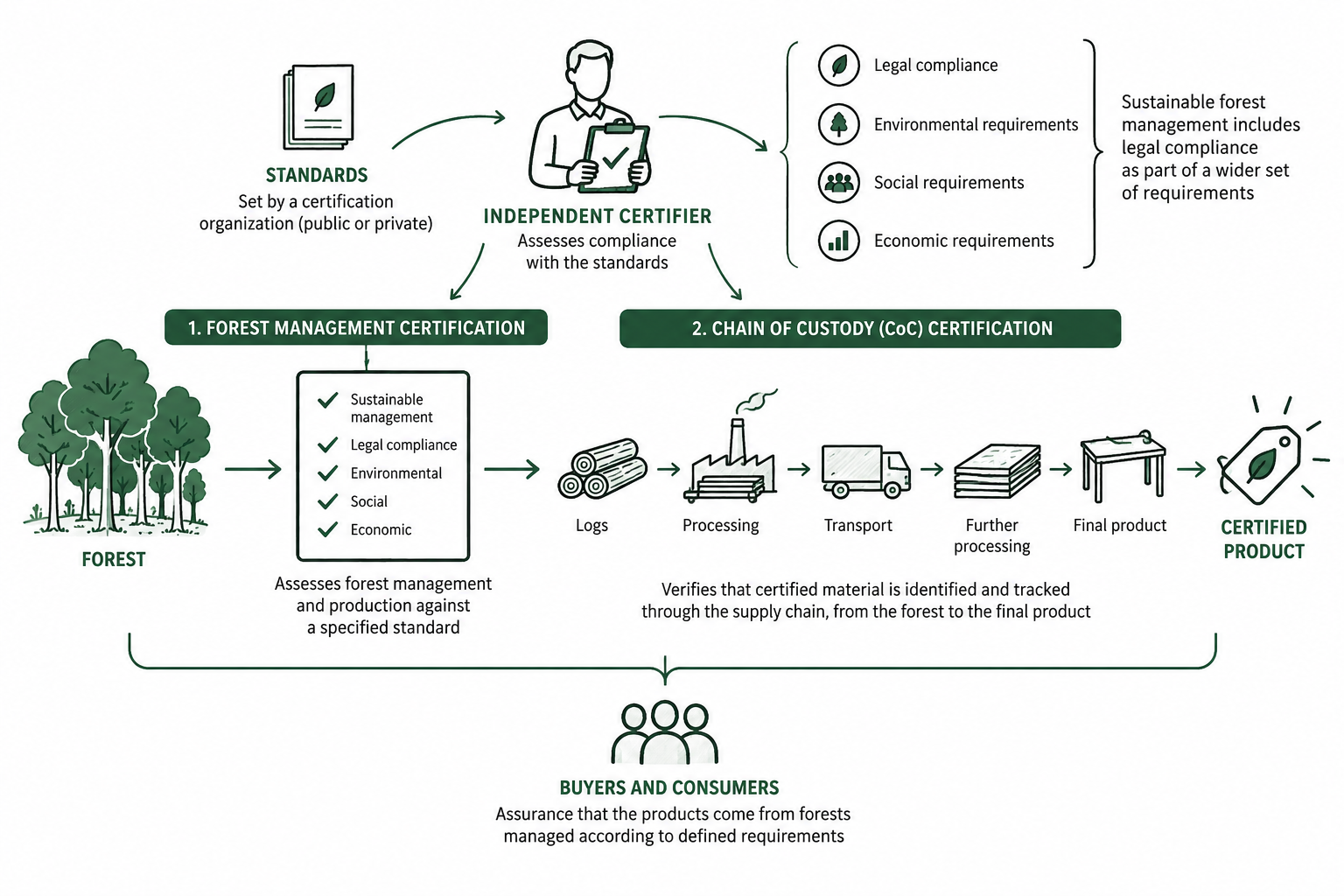
Forest certification is a voluntary, market-based tool that uses independent third-party assessment to verify that forest management and production meet defined standards.
Depending on the scheme, certification may focus on legal compliance or on broader sustainable forest management, covering environmental, social and economic requirements.
Forest certification provides buyers and consumers with assurance that wood and forest products come from forests managed according to defined requirements.
It relies on two complementary components:
- Forest Management (FM) certification, which assesses forest management against a defined standard; and
- Chain of Custody (CoC) certification, which ensures certified material is identified and tracked through the supply chain.
Both are required for an end-product to carry a certification claim or label.
wHAT can certification PROVIDE?
Not all certification schemes have the same purpose or scope. For timber supply chains, it is useful to distinguish between sustainable forest management certification and timber legality certification or verification.
Two main types of certification
Sustainable forest management certification, such as FSC and PEFC, covers a broad range of environmental, social and economic requirements. It addresses legal compliance, but goes further by assessing how forests are managed over the long term, including biodiversity protection, forest regeneration, workers’ rights and the rights of local communities and Indigenous Peoples.
These schemes also use chain-of-custody certification to control certified material as it moves through processing and trade.
Timber legality certification or verification schemes, such as OLB, sustainability framework (PBN), etc, focus primarily on verifying that timber has been legally harvested, processed and traded in accordance with the applicable legal framework. They can also include traceability and chain-of-custody requirements. For example, Bureau Veritas describes OLB as combining verification of forest-sector legal requirements with timber traceability and a chain-of-custody system.
1. Trace the origin of timber
Certification provides a structured framework for timber traceability throughout the supply chain. Chain-of-custody systems establish controls to identify and track certified or verified material as it is purchased, processed and sold.
Depending on the certification scheme, its scope and the chain-of-custody model used, traceability information may include:
- the origin of the timber;
- the forest, concession or harvesting area;
- suppliers and other actors in the supply chain;
- batches, volumes and product movements;
- processing and trade stages.
The level of traceability may vary between certification schemes and supply chains. Where more detailed origin information is required — such as geolocation of harvesting areas or plots — buyers should verify whether this information is provided by the certification scheme or can be obtained from the certified supplier.
2. Verify legality
Legal compliance is a core requirement of both sustainable forest management and timber legality certification schemes. Legality schemes focus specifically on verifying compliance with applicable laws, while sustainable forest management certification includes legality within a broader set of environmental and social requirements.
Depending on the scheme and the applicable national legislation, verification may cover:
- harvesting and land-use rights;
- forest and environmental requirements;
- labour and workers’ rights;
- the rights of local communities and Indigenous Peoples;
- taxes, fees and royalties;
- transport, trade and export requirements.
Compliance is assessed through document reviews, independent third-party audits and field inspections.
3. Support sustainable forest management
Sustainable forest management certification provides assurance that forests are managed according to environmental, social and economic requirements that go beyond legal compliance.
Forest management standards such as FSC and PEFC require certified forest managers to address key aspects of responsible forest management, including:
- long-term forest management planning and monitoring;
- maintenance and regeneration of forest resources;
- protection of biodiversity, habitats and other environmental values;
- protection of soils, water and forest ecosystem functions;
- management of environmental impacts from harvesting activities;
- workers’ rights and working conditions;
- the rights and interests of local communities and Indigenous Peoples.
These requirements are implemented through forest management standards and are subject to independent third-party certification and ongoing audits.
A tool for meeting market requirements
Certification helps companies secure their supply chains, demonstrate responsible sourcing and provide verified information to customers and business partners. It can also support due diligence and compliance with regulatory requirements in different markets.
In the European Union, certification can provide information and independent verification relevant to traceability, legality, origin and risk assessment under the EUDR.
FSC and PEFC have gone further by developing specific voluntary EUDR modules that complement their existing certification systems: the FSC Regulatory Module and the PEFC EUDR Due Diligence System (DDS) module. These voluntary modules build on existing certification and Chain of Custody requirements and introduce additional requirements specifically designed to support EUDR due diligence, traceability, information collection and risk management.
Even without these voluntary EUDR modules, FSC and PEFC certification and legality certifcation can still provide valuable information and independent assurance for risk assessment and risk mitigation. However, operators must identify any information that is not provided through the standard certification system and obtain it separately from their suppliers. This may include, in particular, plot-level geolocation data, production dates, and sufficiently detailed information to map and understand the supply chain and link the timber to its origin.
Forest certification systems
Timber legality verification systems
how can certification support due diligence?
The EU Deforestation Regulation (EUDR) does not recognise certification as automatic proof of compliance. Operators remain responsible for exercising due diligence and demonstrating that products placed on the EU market are:
- legal;
- deforestation-free and forest degradation-free after 31 December 2020;
- associated with no more than a negligible risk of non-compliance.
However, third-party certification can provide valuable information and verification mechanisms that can support due diligence and help operators assess and mitigate risks.
When using certification as part of risk assessment or risk mitigation, operators should consider:
- the scope and requirements of the certification scheme, and the extent to which the information and assurances it provides are relevant to the applicable EUDR requirements. Some forest certification schemes have developed EUDR-specific modules, tools or guidance, and independent assessments are also available;
- the validity and scope of the certificate, Before using certification as part of your due diligence, check that the certificate is valid and that the supplier, activities and products concerned are covered by its scope. This helps ensure that the certification actually applies to your supply.
You can verify certificates directly through the official databases:
- FSC Search – verify an FSC certificate
- PEFC – Find Certified
- OLB – Bureau Veritas
- PBN certificate seach
- Control Union - certificate seach
- Legal haverst - SCS - certificate search
Further guidance
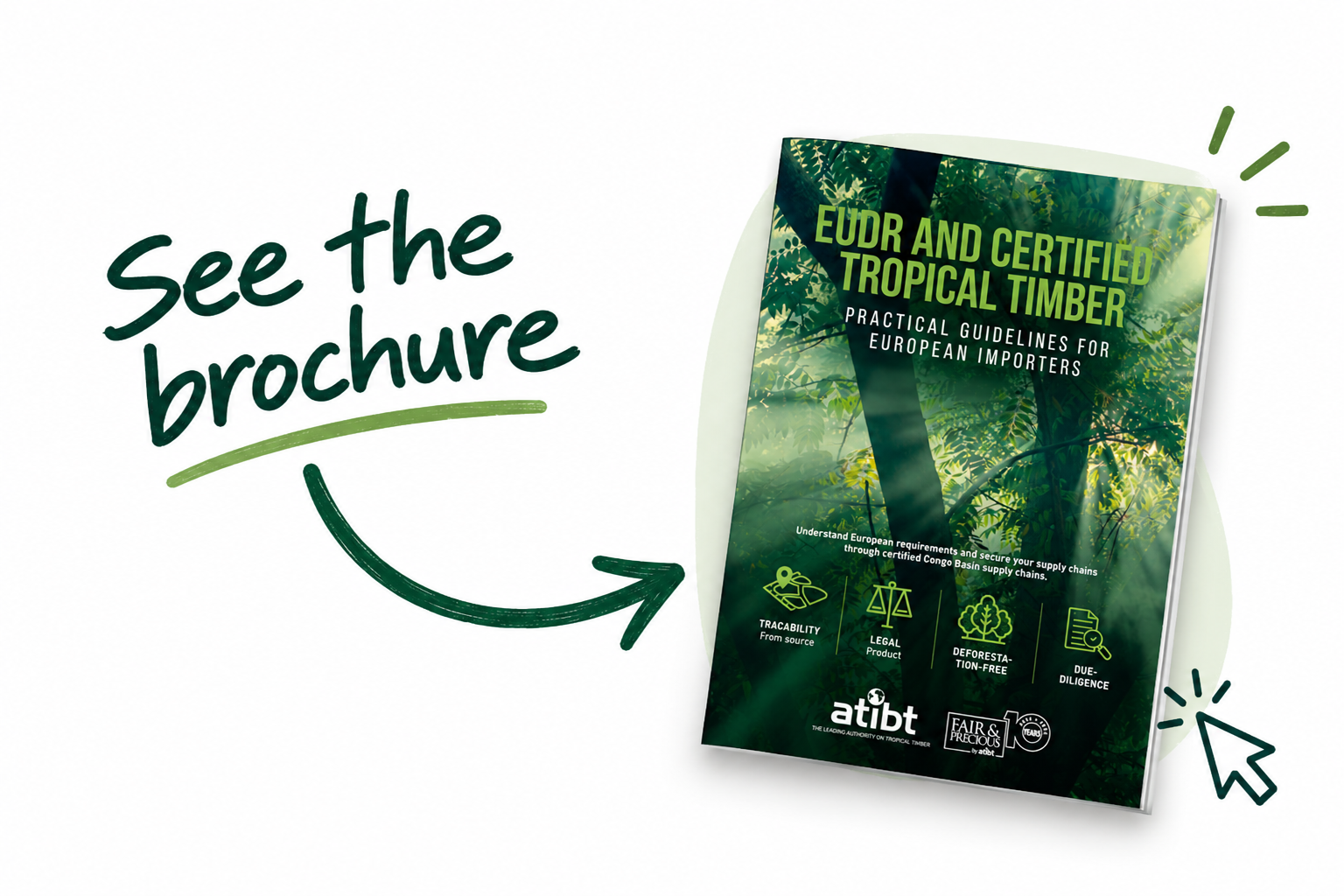
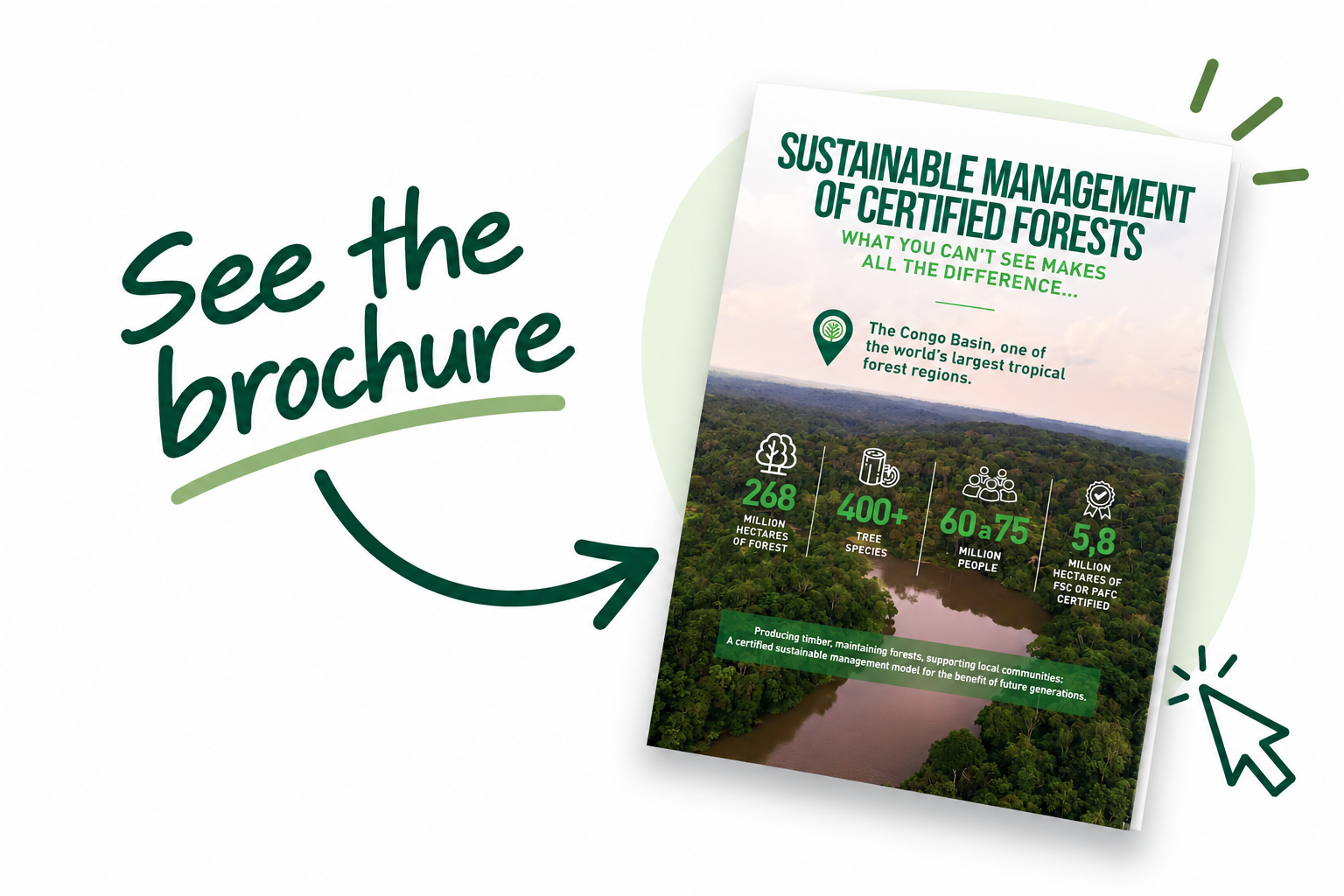
For tropical timber supply chains, ATIBT has published practical guidance on the role of certification in supporting EUDR due diligence. It explains how certification can contribute to traceability, legality verification, risk assessment and risk mitigation, while emphasising that certification does not replace the operator's due diligence obligations. ATIBT has also published a brochure on the sustainable management of certified forests, highlighting how forest certification can support responsible forest management in the Congo Basin.

PEFC
The Programme for the Endorsement of Forest Certification (PEFC) is an international forest certification system that works through the endorsement of national forest certification systems. National standards are developed to reflect local forest, legal and socio-economic conditions, while having to meet PEFC’s international sustainability requirements in order to be endorse
DISCOVER FSC
FSC stands for Forest Stewardship Council and is a global not-for-profit organization that sets the standards for what is a responsibly managed forest. FSC consults with a global network of environmental, social, and economic members to ensure that forest management standards represent everyone’s needs, from Indigenous Peoples to endangered animal species.
DISCOVER OLB by Bureau Veritas
The OLB system or Origine et Légalité des Bois in French, which may be translated as Timber Origin and Legality, was developed in 2004 by Bureau Veritas Certification. It has been applied so far in several Central- and West-African countries and Asia. The system is designed to verify that timber has been legally produced, acquired and sold by a particular forestry or timber company.
DISCOVER The Preferred by Nature Sustainability Framework Certification
The Preferred by Nature Sustainability Framework Certification is a third-party certification system designed to help organisations demonstrate responsible sourcing and sustainable production practices. Building on Preferred by Nature’s experience in legality verification and due diligence, the framework covers a broader range of environmental, social and governance requirements, together with traceability and supply-chain due diligence. It can be applied through different certification scopes, including sustainable land management, chain of custody and due diligence systems, and includes specific tools and requirements to support companies subject to the EUDR.
DISCOVER TLV by Control Union
The Timber Legality Verification (TLV) certification programme was developed by Control Union to provide independent third-party verification of timber legality and traceability. The TLV standard can be applied to organisations throughout the timber supply chain to assess and mitigate risks related to illegal harvesting, processing and trade.
The programme covers different scopes, including forest management, Chain of Custody (CoC) and Due Diligence Systems (DDS), allowing companies to verify legal compliance and maintain control of timber through the supply chain.
TLV has also evolved to address current market requirements, including the EU Deforestation Regulation (EUDR), with requirements and services supporting due diligence, traceability and the assessment of risks related to legality, deforestation and forest degradation.
Official information and current TLV documentation are available from Control Union – Timber Legality Verification (TLV).
DISCOVER Legal Harvest by SCS
Legal Harvest™ by SCS Global Services
SCS LegalHarvest™ Verification (LHV) provides independent third-party verification of the legal origin and traceability of timber and forest products. The system addresses the legal right to harvest, process, transport and export timber and includes requirements for forest-level legality verification and Chain of Custody.
LegalHarvest™ can therefore provide useful verified information on legality, origin and traceability to support responsible sourcing and due diligence.
DISCOVER