


Republic of the Congo
Overview of timber sector of the Republic of the Congo
Supply chain actors
According to the 2025 Joint Annual Report of the EU–Republic of the Congo FLEGT VPA, the country has 60 forest concessions covering approximately 15.22 million hectares. The forestry sector comprises 35 industrial forestry companies (2024 data).
Major forestry companies in terms of allocated concession areas include CIB-Olam (2.08 million ha), IFO-Interholco (1.16 million ha) and SEFYD (over 1 million ha).
Production and processing
Main harvested species
According to the 2025 Joint Annual Report of the EU–Republic of the Congo FLEGT VPA, approximately 52 timber species were harvested in 2025. National log production remains dominated by two species, which together account for approximately 42% of total production:
-
Sapelli (Entandrophragma cylindricum)
-
Okoumé (Aucoumea klaineana)
Okoumé is predominantly harvested in the southern forest massifs and Sapelli in the northern forest massif.
Okan and Tali are the third and fourth most harvested species, respectively. Together, the four leading species account for approximately 67% of national log production.
Other commercially harvested species include:
-
Okan (Cylicodiscus gabunensis)
-
Tali (Erythrophleum ivorense, Erythrophleum suaveolens)
-
Ayous (Triplochiton scleroxylon)
-
Iroko (Milicia excelsa)
-
Padouk (Pterocarpus soyauxii)
-
Kosipo (Entandrophragma candollei)
-
Wengé (Millettia laurentii)
-
Azobé (Lophira alata)
-
Bossé (Guarea cedrata)
-
Limba (Terminalia superba)
-
Sipo (Entandrophragma utile)
-
Mukulungu (Autranella congolensis)
Further information on commercial timber species is available through the Bois Congo platform.
Sources: EU–Republic of the Congo FLEGT VPA, Joint Annual Report 2025, Section 5.1, Table 7; ITTO, Tropical Timber Market Report, February 2026; Bois Congo.
The northern forest massif, which is much larger than the southern forest massifs and contains important reserves of high-value commercial timber species, is characterised by large forest concessions and integrated industrial operations. It remains a major source of industrial timber production in the Republic of the Congo.
The development of local timber processing remains a strategic priority for the Congolese government. In accordance with Law No. 33-2020 of 8 July 2020 establishing the Forest Code, the ban on log exports entered into force on 1 January 2023, subject to specific exemptions. Although processed timber has gained importance in exports, industrial capacity and investment remain insufficient to achieve the full diversification of the timber industry.
According to the 2025 Joint Annual Report of the EU–Republic of the Congo FLEGT VPA, the country has 81 timber processing units, compared with 61 reported in 2020. Primary processing activities, particularly sawing, rotary peeling and veneer slicing, account for around 60% of these units.
Industrial facilities in the north are generally more modern and integrated, while equipment and processing capacities vary considerably in the south. The government is promoting further industrial development through special economic zones, including the Plateformes Industrielles du Congo (PICP) in Pointe-Noire, although investment implementation remains slow.
The domestic timber market remains largely supplied by informal artisanal logging. Annual domestic sawnwood consumption is estimated at approximately 200,000 m³. Domestic logging permits (Permis d'Exploitation Domestique – PED), introduced under the 2020 Forest Code, were not yet operational in 2025. Special permits (Permis spéciaux – PS) authorised only approximately 1,840 m³ of timber in 2025, representing a limited contribution to domestic market supply.
Although industrial forestry companies are increasingly contributing to the domestic market, high production and transport costs limit their competitiveness compared with informal suppliers. Improving the availability of legally sourced timber, formalising artisanal logging and developing local processing capacity remain major challenges for the Congolese timber sector.
Export
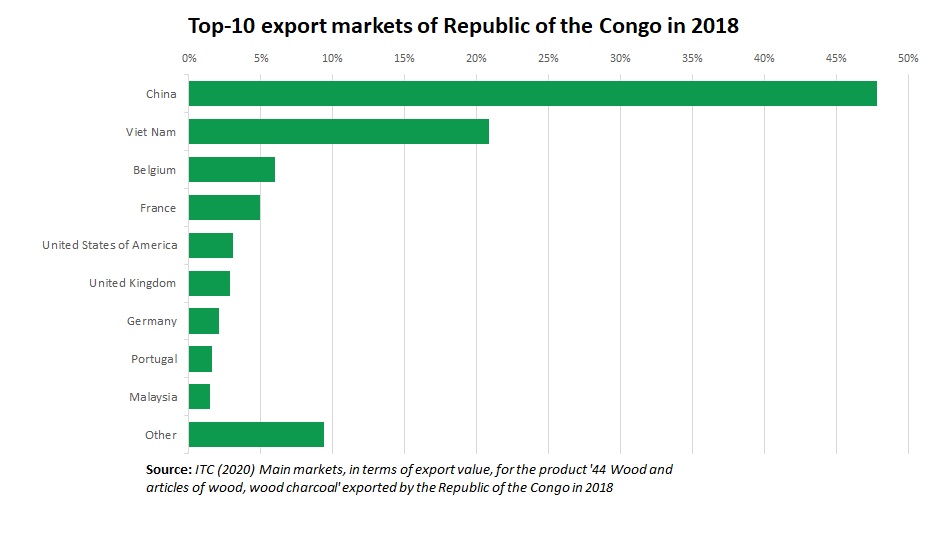
According to the MEF, total forest production in 2018 was around 1.8 million m3 of which 44% (0.8 m3) was exported as logs. Over 80% of output was exported to Asia, 16% to Europe and under 1% to Africa. The remainder of Congo's timber production is exported as sawn timber.
The Congolese timber industry therefore remains partly focused on the export of logs, despite the legal obligation (since Law 16-2000) to transform a minimum of 85% of the logs produced by each forestry company operating on Congolese territory. Recently, new measures have been taken by the Congolese government to increase the rate of log processing: the new forestry law (Law 33-2020) provides for the full processing of logs on national territory, with the exception of a list of species that has yet to be defined. Nevertheless, the strategy remains the strict prohibition of log exports by 2022, as provided for by the CEMAC. Other incentives are also being considered to increase log processing levels, including fiscal measures.
Logistics infrastructure
Northern Congo is relatively landlocked and far from shipping ports.
The main export route for timber and timber products is via the Pointe-Noire port in the south of the country, and the Douala port in neighbouring Cameroon.
Data table
| Production (X 1000m3) |
Imports (X 1000m3) |
Domestic consumption (X 1000m3) |
Exports (X 1000m3) |
|
|---|---|---|---|---|
| logs | 2.193 | 0 | 1.253 | 941 |
| Sawnwood | 332 | 1 | 160 | 173 |
| Veneer | 47 | 0 | 32 | 14 |
| Plywood | 30 | 0 | 30 | 0 |
ITTO (2019), data 2017