


Gabon
Forest resources and context of Gabon
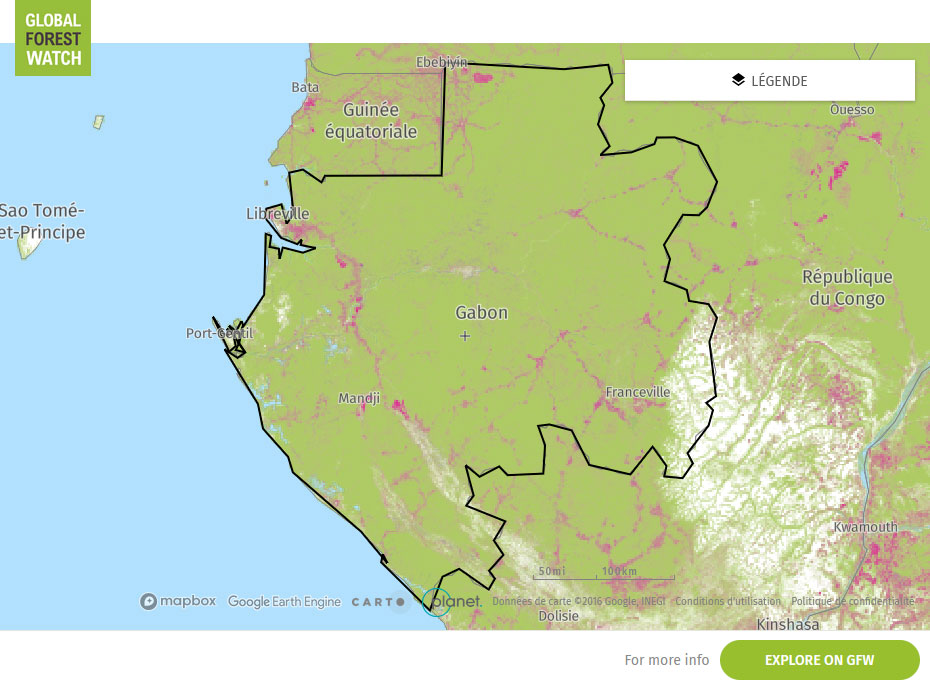
According to an AfDB study conducted by FRMi in 2018, Gabon has about 22.3 million hectares of forest areas and from FAO study 23,5 million hectares (2020), which represents 87% of the nation's total area. Almost all of the forest area consists of primary or naturally regenerated forests.

Land surface
25.8million ha
Forest cover
23.5million ha
Production forest
14million ha
Forest ownership
100% publicly
Forest lost
xx
% per year
Forest ownership in Gabon
The full 100% of the Gabonese forests is owned by the state, although the management of the forest areas can be divided into three different categories:
- Production forests which are managed by private concessionaires, although the management rights are exclusively administered by the state.
- Protection forests, which are directly managed by the state. Gabon has 13 national parks and some other protected areas, covering together approximately 12% of the country.
- The domain rural, which is generally land and forest where rural communities and forest dwellers are free to exercise their customary rights, provided that they respect the conditions imposed by the forest administration.
Forest resources in Gabon
Types of forest
There are three major forest types:
- Evergreen rainforest in the west, which has been heavily harvested, degraded and in some areas reduced to secondary forest characterized by the species Okoumé (Aucomeaklaineana), one of the most important species of the Gabonese timber sector, and Ozigo (Dacryodesbuettneri);
- Closed humid central Gabonese forest, covering most of the country, with many species found to similar forests found elsewhere in the region such as Azobé (Lophiraalata), Mahogany species (Entandrophragma spp. and Khaya spp.), Aiélé (Canariumschweinfurthii) and Ayous (Triplochitonscleroxylon);
- Semi-deciduous forest type in the northeast, characterized by trees such as Limba (Terminalia superba), Wengé (Millettialaurentii) and Ayous (Triplochitonscleroxylon).
With a low overall population density and large forest area Gabon faces a relatively low forest loss of 0.12% per year and an average degradation rate of 0.09%.
The main causes for deforestation are small-scale agriculture established along roadways and urban development, while the main causes of forest degradation are industrial mining and illegal logging in opened-up areas.
Gabon is a forest country where the fauna and flora are still well preserved and protected in thirteen national parks and some other protected areas (covering in total more than 12% of the country'sterritory).
The Lopé National Park is a UNESCO World Heritage Site.
Gabon is divided into 9 provinces, each headed by a governor, which are in turn subdivided into departments under a prefect and, in some cases, into districts under a sub-prefect.
|
CORRUPTION PERCEPTION INDEX (Transparency international)
0 is highly corrupt, 100 is very clean. |
ILLEGAL DEFORESTATION AND ASSOCIATED TRADE (IDAT) Risk (Forest Trend) 84.06/100
00 is higher risk, 0 is lower risk
|
|
SOURCING HUB RISK SCORE (Preferred by nature) 3/100 0 is higher risk, 100 is lower risk
|
COUNTRY DEFORESTESTATION CLASSIFICATION LIST - EUDR (European Commission) LOW risk category For more information about the methodology, see here
|
Interpretation of Risk Indicators
Subnational variations in risks
| HARVESTING SOURCE | DUE DILIGENCE COMPLEXITY | DUE DILIGENCE CONSIDERATION |
|---|---|---|