


China
Forest resources and context of China
According to the FAO Global Forest Resources Assessment 2025, China's forest area totals approximately 227 million hectares. Through large-scale afforestation programmes, the country has continuously expanded its forest estate and established a nationwide continuous forest inventory and remote sensing dynamic monitoring system. Domestically sourced plantation timber forms the backbone of wood supply. Since 2017, a comprehensive ban on commercial harvesting of natural forests has been in effect. Overall legality risk for domestically sourced raw materials is low. However, domestic wood-processing demand far exceeds domestic production capacity: over half of the country's processing-grade timber is imported from other countries.Major source countries for imported timber include New Zealand (hardwood lumber), Russia (hardwood lumber, broadleaf sawnwood), Thailand, Papua New Guinea, Canada, the United States, Germany, Poland and Vietnam. Imported pulp mainly comes from Brazil (hardwood pulp), Indonesia (hardwood pulp), Chile (softwood pulp + hardwood pulp), Canada (softwood pulp), Thailand (hardwood pulp), Finland (softwood pulp), Uruguay (hardwood pulp), Russia (softwood pulp), Malaysia (hardwood pulp) and Sweden (softwood pulp).

Land surface
960million ha
Annual Forest Change
+1.690
th ha/yr (2015-2025)
Forest cover
227million ha
Production forest
94.67million ha
Forest ownership
57.4million ha
Forest resources in China
Types of forest
Under China’s Forest Law, forests are primarily classified by function as public welfare forests or commercial forests.
According to the latest National Forest Resources Inventory (2014–2018), approximately 94.67 million hectares are classified as commercial production forests. Domestic timber supply mainly comes from collective forests and forest plots contracted to rural households, while commercial harvesting is heavily restricted in most state-owned forests.
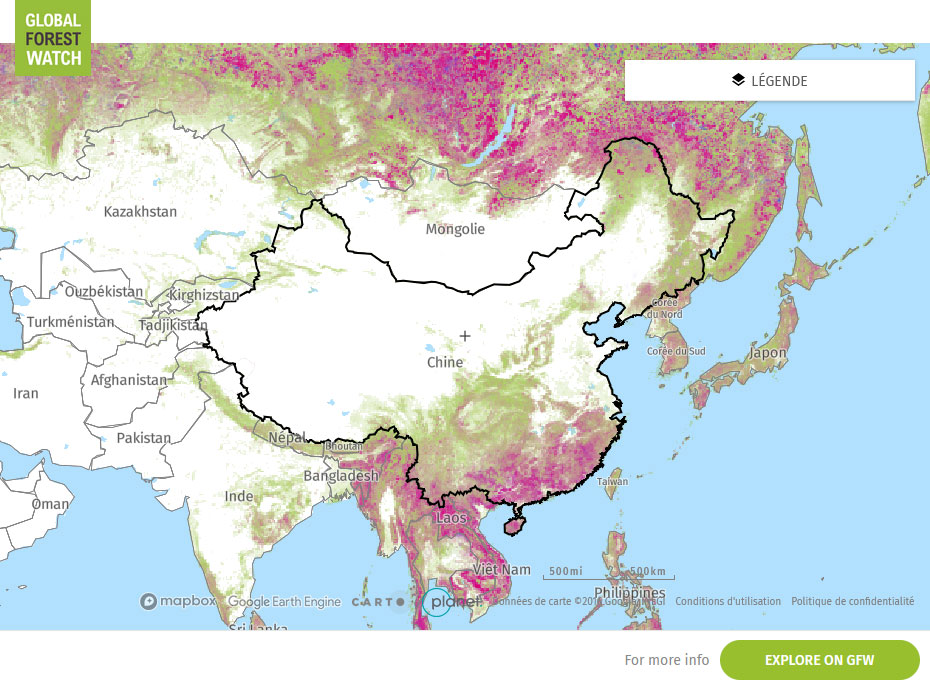
According to the FAO Global Forest Resources Assessment 2025, China has around 227 million hectares of forest, with a national forest coverage rate of 25.09% in 2025. This represents significant long-term growth from approximately 121.86 million hectares and 12.71% forest coverage at the time of the first National Forest Inventory (1973–1976).
China has significantly expanded its forests since the late 1970s, through successive large-scale afforestation and ecological restoration programmes. These efforts intensified from the late 1990s onwards, with policies aimed at protecting natural forests, restoring degraded land, converting cropland to forest and expanding planted forests.
Forest expansion has occurred across most provinces and regions, particularly in southern plantation zones, the Loess Plateau, the Beijing–Tianjin–Hebei region and south-western areas affected by rocky desertification. Planted forests have played a major role in this expansion, while harvesting in natural forests has become increasingly restricted. Major species and species groups planted in China include Cunninghamia lanceolata, Populus, Eucalyptus, Larix gmelinii, Pinus massoniana, Pinus tabuliformis, Cupressus funebris, Pinus elliottii, Robinia pseudoacacia and Quercus.
Although the overall national trend is one of forest expansion, localised and sporadic forest-cover reductions still occur, mainly in connection with construction and infrastructure development, licensed industrial and mining activities, agricultural land-use adjustments, fires and pest outbreaks. Overall, forest gains and losses remain localised and patchy, with no widespread or persistent pattern of deforestation at the national level.
Timber harvesting legality risks
Despite the overall increase in China’s forest area, legality risks may occur at the harvesting stage. Key risks include:
-
sporadic illegal or unauthorised harvesting without a valid Forest Harvest Permit;
-
irregular transfer of harvesting quotas or use of Forest Harvest Permits beyond authorised boundaries or volumes; and
-
gaps in the supervision of small-scale and scattered harvesting, particularly in remote mountainous areas where local enforcement capacity may be limited.
These risks relate primarily to timber harvested within China. However, China’s wood-processing industry also relies significantly on imported timber, creating supply chains that may involve forests, operators and legal requirements in other countries.
Timber production and imports
Despite the expansion of its domestic forest resources and planted forests, China’s timber demand exceeds domestic supply, making imported timber an important component of the country’s wood-processing industry.
China imports a wide range of logs, sawn timber and other wood products, which are processed for both the domestic market and the manufacture of products that may subsequently be exported.
For operators sourcing timber or timber products from China, it is therefore important to determine whether the wood is domestically harvested or imported. For imported material, particular attention should be paid to the country and place of harvest, species, legality of harvest and supporting supply-chain documentation.
|
CORRUPTION PERCEPTION INDEX (Transparency international) Corruption Perception Index 43/100
0 is highly corrupt, 100 is very clean. |
ILLEGAL DEFORESTATION AND ASSOCIATED TRADE (IDAT) Risk (Forest Trend)
23.70/100
100 is higher risk, 0 is lower risk
|
|
SOURCING HUB RISK SCORE (Preferred by nature) 77/100 0 is higher risk, 100 is lower risk
|
COUNTRY DEFORESTESTATION CLASSIFICATION LIST - EUDR (European Commission) LOW risk category For more information about the methodology, see here
|