


Chine
Contexte général et ressources forestières de la Chine
Selon l’évaluation des ressources forestières mondiales publiée par la FAO en 2015, la Chine dispose d’environ 208,3 millions d’hectares de terres forestières, ce qui représente 22,1 % de sa superficie terrestre totale.
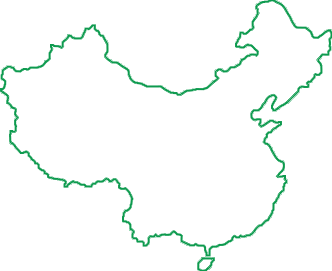
Surface pays
942.5million ha
Surface forestière
208.3million ha
Forêt de production
93million ha
Propriété forestière
57.4% propriété publique
Les ressources forestières en Chine
Types de forêts
La Chine compte environ 11,6 millions d’hectares (5,6 %) de forêts primaires, 117,7 millions d’hectares (56,5 %) « d’autres forêts régénérées naturellement » et près de 79 millions d’hectares (37,9 %) de forêts plantées. Les dix espèces (groupes) d’arbres les plus importants provenant des forêts naturelles sont : Quercus, Betula, Larix gmelinii, Pinus massoniana, Pinus yunnanensis, Picea asperata, Abies fabri, Cupressus funebris, Cunninghamia lanceolata et Pinus densata.
Selon l’évaluation des ressources forestières mondiales publiée par la FAO en 2015, la Chine dispose d’environ 208,3 millions d’hectares de terres forestières, ce qui représente 22,1 % de sa superficie terrestre totale. La couverture forestière a progressé en Chine au cours des 25 dernières années, avec une augmentation de la surface forestière d’environ 1,1 % par an grâce au Programme de protection des forêts naturelles, qui a permis de réduire la production de bois provenant des forêts naturelles et de mettre en œuvre un programme de plantation d’arbres (FAO et TFT).
La Chine dispose maintenant de la plus grande superficie de plantations au monde et celles-ci sont principalement constituées d’espèces à croissance rapide. Les dix espèces les plus répandues dans les plantations forestières chinoises sont : Cunninghamia lanceolata, Populus, Eucalyptus, Larix gmelinii, Pinus massoniana, Pinus tabuleaformis, Cupressus funebris, Pinus elliottii, Robinia pseudoacacia et Quercus.
La Chine a actuellement le taux de boisement le plus élevé du monde et sa couverture forestière est passée de 12 % il y a trente ans à plus de 21 % en 2013. Le pays continue de mettre en œuvre des mesures destinées à améliorer la qualité et la quantité de ses forêts et vise à porter la couverture forestière à 23 % (soit 223 millions d’hectares) et le volume de bois sur pied à 9 % (soit 16,5 milliards de mètres cubes) d’ici 2020. L’Administration nationale des forêts et des prairies (ANFP) chinoise prévoit de façon optimiste une augmentation de l’approvisionnement en bois pour le marché domestique de 180 millions de mètres cubes par an en 2010 à 300 millions de mètres cubes par an en 2020 et anticipe en même temps une augmentation de la demande industrielle (sans inclure l’utilisation privée de bois de chauffage) à 467 millions de mètres cubes par an (en excluant le papier recyclé), ce qui représente un déficit de 167 millions de mètres cubes par an. Toutefois, l’OIBT a indiqué que ce déficit avait atteint 150 millions de mètres cubes en 2011 et estime que cet écart s’est accentué et s’est élevé à plus de 180 millions de mètres cubes (en équivalent de bois rond) en 2015.
Selon l’article 47 de la nouvelle loi forestière promulguée en 2019, les peuplements forestiers chinois sont classés en deux catégories, les forêts écologiques et les forêts commerciales :
- les forêts écologiques : elles sont situées dans des zones importantes ou fragiles d’un point de vue écologique qui sont protégées de manière stricte pour préserver leur fonction écologique ;
- les forêts commerciales : elles ne sont pas classées comme des forêts écologiques. Leur fonction principale est la production de bois et d’autres produits forestiers et elles ont pour but de générer des profits.
Need to analyse deforestation risk at plot level? — WHISP

Open Foris Whisp (“What's in that plot?”) is a free and open-source solution developed by the Food and Agriculture Organization (FAO) to support rapid, plot-level analysis of land use and deforestation risk. It combines geospatial datasets and satellite-based information to provide transparent insights for a specific location, helping users understand whether the area is forest, agricultural land, or potentially linked to deforestation or disturbance.
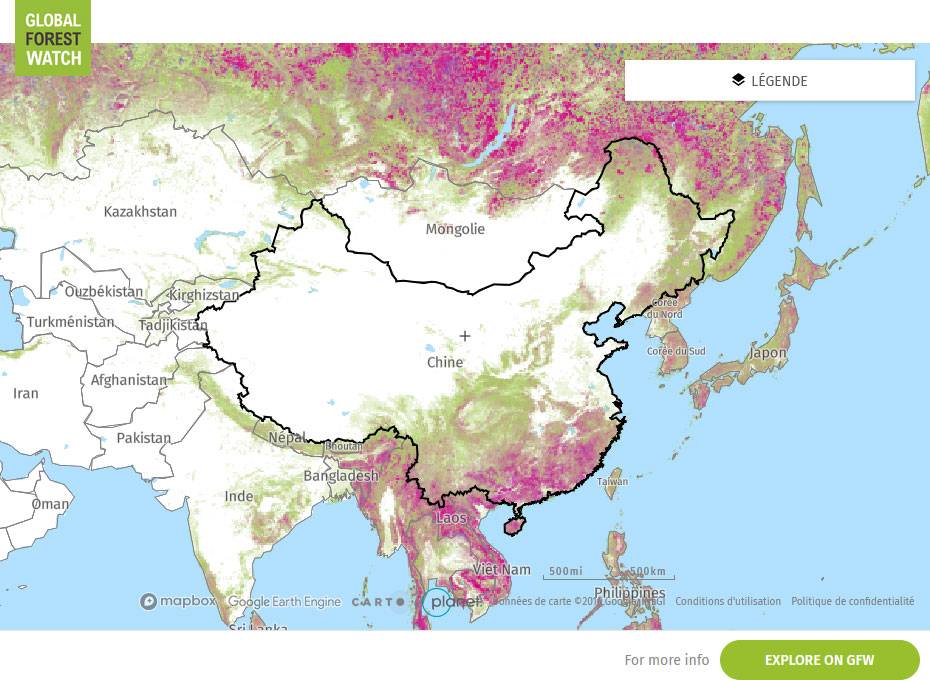
WHISP uses GPS points or plot polygons to perform an analysis based on multiple public datasets on forests and land use.
The aim is to identify plots that may present a potential deforestation risk and those for which further checks may be necessary.
|
CORRUPTION PERCEPTION INDEX (Transparency international) Corruption Perception Index 43/100
0 is highly corrupt, 100 is very clean. |
ILLEGAL DEFORESTATION AND ASSOCIATED TRADE (IDAT) Risk (Forest Trend)
23.70/100
100 is higher risk, 0 is lower risk
|
|
SOURCING HUB RISK SCORE (Preferred by nature) 77/100 0 is higher risk, 100 is lower risk
|
COUNTRY DEFORESTESTATION CLASSIFICATION LIST - EUDR (European Commission) LOW risk category For more information about the methodology, see here
|
Interpretation of Risk Indicators
China-Specific and regional Risk Approach
The risk profile of China's timber supply chains is primarily influenced by four key factors.
Forest classification plays an important role in determining the legal conditions under which timber can be harvested. Chinese forests are divided into ecological public welfare forests and commercial forests, each subject to different management objectives and harvesting restrictions.
Harvesting authorisations are another essential consideration. Assessing the legality of timber harvesting requires verifying the existence and validity of the relevant Forest Harvest Permit, compliance with applicable harvesting quotas and the completeness of supporting approval documentation.
Local governance and enforcement practices can also influence compliance risks. The effectiveness of forestry supervision may vary depending on the resources and capacity of local forestry and grassland authorities, the frequency of forest patrols and the implementation of monitoring and record-keeping systems.
Imported timber represents an additional source of risk that must be considered. China is a major importer of timber and wood products, sourcing raw materials and semi-finished products from numerous countries. Consequently, risks associated with illegal logging, deforestation and forest conversion in countries of origin may be transmitted through China's timber supply chains. Assessments must therefore consider not only domestic harvesting conditions but also the origin, legality and traceability of imported timber.
Risk Interpretation by Forest Category
I. Ecological Public Welfare Forests
Ecological public welfare forests are subject to a strict regulatory framework under China's Forest Law and the Natural Forest Conservation and Restoration Programme. These forests are primarily managed for ecological protection, and commercial harvesting is generally prohibited or subject to significant restrictions.
Their management is supported by administrative documentation and monitoring systems, including forest tenure registration records, ecological management plans and forest patrol records. These documents, which may be maintained in paper or electronic formats, provide an important basis for verifying forest management practices and compliance with applicable regulations.
Despite these regulatory safeguards, some residual risks remain. These may include isolated cases of irregular harvesting approvals, unlawful encroachment on protected forest areas or excessive harvesting carried out under the guise of authorised forest tending operations. In certain areas, insufficient ecological compensation may also contribute to small-scale illegal harvesting activities.
II. Commercial Forests
China applies a forest classification-based management system under which commercial forests are designated primarily for timber production and other economic uses. Unlike ecological public welfare forests, commercial forests provide a legal framework for commercial timber harvesting, subject to applicable regulatory requirements.
In recent years, the Chinese authorities have progressively simplified certain administrative procedures for harvesting in plantation commercial forests. Nevertheless, harvesting activities generally remain subject to the relevant authorisation requirements, including the possession of a valid Forest Harvest Permit where applicable.
Compliance risks therefore persist, particularly where harvesting takes place without the required authorisation, exceeds permitted volumes or extends beyond the approved harvesting area. Verification of harvesting documentation and consistency between authorised and actual harvesting activities remains essential.
Supply Chain Traceability and Residual Risks
Official harvesting permits and other administrative approval documents are important elements of legality verification, but they are not sufficient on their own to establish the legal origin of timber.
A robust risk assessment should therefore be supported by consistent, cross-verifiable documentation covering the different stages of the supply chain, from harvesting and intermediate trading to processing and final sale. This includes checking the consistency of information relating to timber origin, species, harvested volumes, transport and commercial transactions.
For domestically sourced timber, residual risks may arise from forged or inaccurate harvesting permits, as well as discrepancies between declared harvesting locations, authorised volumes and actual harvesting activities.
For imported timber, additional risks may originate in the countries where the wood was initially harvested. These include illegal logging, deforestation and forest conversion, particularly where regulatory enforcement or traceability systems are insufficient. Such risks may persist even when timber is subsequently processed or traded through China.
Consequently, the assessment of timber originating from or traded through China should combine verification of domestic regulatory compliance with due diligence on imported raw materials and semi-finished products. Particular attention should be paid to the original country of harvest and the availability of reliable, verifiable supply chain information.
References
-
FAO, Global Forest Resources Assessment 2025 – China Country Report.
-
FAO, forest land structure and land-use classification standards; China's forest classification (public welfare/commercial; natural/plantation).
-
Preferred by Nature, China Timber Legality Risk Assessment Report, 2021.
-
NFGA, Annual Forestry Administrative Law Enforcement Statistical Reports, 2020–2025; Domestic Timber Legality Verification Guidelines.
-
Forest Law of the People's Republic of China; Regulations on the Administration of Forest Harvest Permits.
-
Chinese Academy of Forestry, Domestic Timber Supply Chain Compliance Traceability Study, 2025.