


喀麦隆
喀麦隆的森林资源和背景
根据森林和野生动物部(2018 年)的数据,喀麦隆拥有约 2,200 万公顷森林,占国家总面积的 46% 左右。26,000 公顷(森林面积的 0.1%)为人工林。
陆地面积
47.3百万公顷
森林覆盖
20.2百万公顷
生产林
15.7百万公顷
森林所有权
100% 公有
CONTEXT
According to the Ministry of Forests and Wildlife (2025) and FAO assessments (2025), Cameroon covers approximately 47.6 million hectares, of which 19.1 million hectares are forested in 2025, representing nearly 40% of the national territory.
Forest management is overwhelmingly based on natural forests under public ownership (100%), with approximately 12.1 million hectares of production forests. These include around 7.1 million hectares of Forest Management Units (FMUs/UFA), 2.35 million hectares of communal forests, and 2.59 million hectares of community forests.
The structure of the forest estate—divided between Permanent Forest Domain (PFD) and Non-Permanent Forest Domain (NPFD)—combined with varying levels of governance and control, creates significant differences in risk across supply chains.
Forest loss in Cameroon, estimated at around 117,000 hectares per year over the period 2020–2025 (FAO 2025), is mainly concentrated in the southern and eastern forest regions, particularly along agricultural frontiers and in accessible areas. It corresponds to an annual loss rate of about 0.6% of total forest cover, characterised by a diffuse and progressive dynamic driven by anthropogenic pressures, rather than large-scale industrial conversion.
This deforestation is primarily driven by:
- agricultural expansion (both industrial plantations and smallholder farming),
- fuelwood and charcoal production,
- mining activities, and
- infrastructure development.
In parallel, forest degradation and legality risks are strongly linked to:
- illegal logging and informal harvesting,
- misuse or irregular allocation of permits,
- weak law enforcement and limited administrative control, and
- corruption affecting parts of the supply chain.
In this context, operators sourcing from Cameroon must go beyond country-level indicators and conduct a robust, supply chain–specific due diligence, taking into account forest type, origin of the timber, and local risk dynamics.
全球森林观察地图
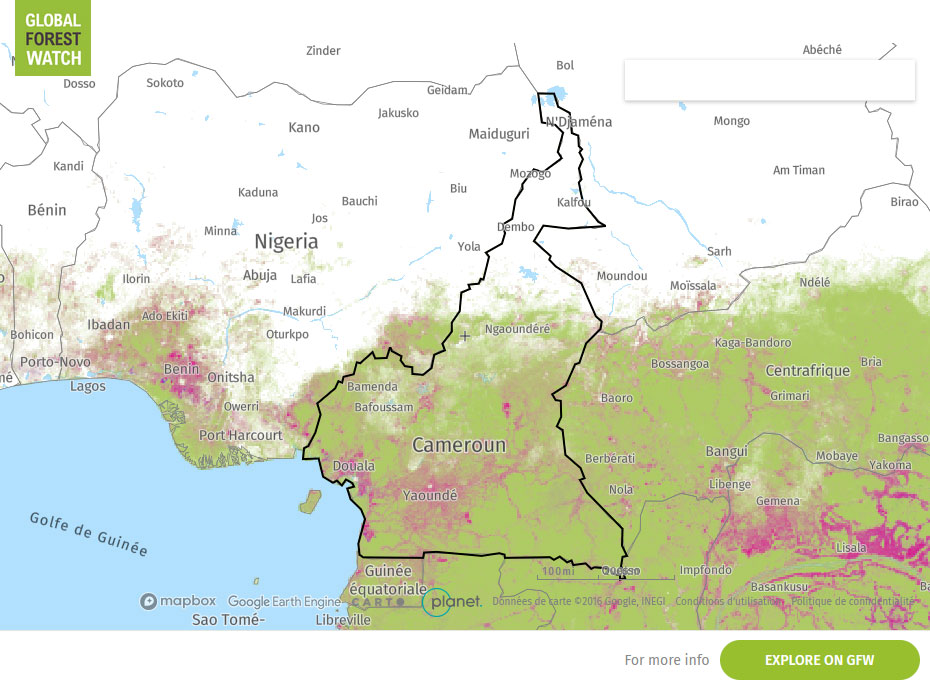
RISK SCORES
|
CORRUPTION PERCEPTION INDEX (Transparency international) 26
/100 0 is highly corrupt, 100 is very clean. |
ILLEGAL DEFORESTATION AND ASSOCIATED TRADE (IDAT) Risk (Forest Trend) 91.75
/100 100 is higher risk, 0 is lower risk
|
|
SOURCING HUB RISK SCORE (Preferred by nature) 0
/100 0 is higher risk, 100 is lower risk
|
COUNTRY DEFORESTESTATION CLASSIFICATION LIST - EUDR (European Commission) Standard risk category For more information about the methodology, see here
|
Sources :
Interpretation of Risk Indicators
Subnational variations in risks
Regional and Structural Risk Considerations
Risk levels may vary significantly within producer countries. However, in Cameroon, risk assessment should not rely solely on geographic location. It must be structured around a combination of spatial, legal, and operational factors.
Cameroon-specific risk approach:
Risk is primarily determined by:
- Forest domain: Permanent Forest Domain (PFD) vs Non-Permanent Forest Domain (NPFD)
- Type of harvesting title or permit
- Level of governance and effective control
Risk interpretation by forest domain:
- Permanent Forest Domain (PFD) (e.g. industrial concessions / FMUs):
– More structured regulatory framework
– Availability of management plans and documentation
– Remaining risks: allocation of titles, compliance with management plans, social and environmental obligations - Non-Permanent Forest Domain (NPFD) (e.g. community forests, small-scale permits, unclassified areas):
– Higher overall risk profile
– Limited planning and weaker traceability
– Higher exposure to land-use change and conversion
– Often limited administrative oversight - Implications for due diligence:
• Do not rely solely on country or regional risk classification
• Assess risk at supply chain level (from plot to export)
• Verify consistency of documents across the supply chain
• Prioritise supply chains with stronger traceability and third-party verification where relevant
• Apply enhanced scrutiny for supplies from NPFD or high-pressure areas
Important:
The presence of official documents does not, by itself, guarantee legality. Compliance must be demonstrated through a coherent and verifiable set of information covering the entire supply chain.
Sources:
• FAO, Global Forest Resources Assessment 2025 – Cameroon
• FAO, forest domain structure and land-use classifications (Permanent vs Non-Permanent Forest Domain, pp. 15–27)
• Preferred by Nature, Timber Legality Risk Assessment – Cameroon (2021)
• TRAFFIC & FODER (2025), Guide to verify the legality of timber from Cameroon
| HARVESTING SOURCE | DUE DILIGENCE COMPLEXITY | DUE DILIGENCE CONSIDERATION |
|---|---|---|
| Forest Management Units (FMUs/UFAs) Permanent forest domain (PFD) |
Moderate | Long-term concessions managed under approved forest management plans. Generally provide the highest level of traceability, planning and regulatory oversight. Verify concession rights, management plans, annual operating permits and harvesting records. |
| Council Forests Permanent Forest Domain (PFD) |
Moderate | Managed under approved management plans. Verify legal allocation, harvesting authorisations and implementation of management requirements. |
| Community Forests Non-Permanent Forest Domain (NPFD) |
High | May present additional challenges regarding governance capacity, traceability, implementation of management plans and land-use change risks. Enhanced verification is recommended |
| Vente de Coupe Non-Permanent Forest Domain (NPFD) |
High to Very High | Short-term permits not supported by long-term forest management plans. Due diligence may be more complex due to limited long-term planning, shorter permit duration and greater need to verify harvesting boundaries, legality and traceability. |
| Small-scale permits (ARB, AEB, APC, etc.) Non-Permanent Forest Domain (NPFD) |
High to Very High | Limited-scope permits that often require extensive verification of timber origin, permit justification and chain of custody. Enhanced scrutiny is strongly recommended. |