


中国, 中华
中国的森林资源和背景
根据粮农组织 (FAO) 2015 年全球森林资源评估的数据,中国拥有约 2.083 亿公顷林地,占土地总面积的 22.1%。
陆地面积
942.5百万公顷
森林覆盖
208.3百万公顷
生产林
93百万公顷
森林所有权
57.4% 公有
森林资源
森林类型
约 1,160 万公顷 (5.6%) 为原生林,1.177 亿公顷 (56.5%) 为“其他自然再生林”,其余近 7,900 万公顷 (37.9%) 为人工林。
天然林中最重要的十个树种(种群):
- 栎树、
- 桦树、
- 落叶松、
- 马尾松、
- 云南松、
- 云杉、
- 冷杉、
- 柏树、
- 杉木、
- 和高山松。
根据粮农组织 (FAO) 2015 年全球森林资源评估的数据,中国拥有约 2.083 亿公顷林地,占土地总面积的 22.1%。由于出台了减少天然林木材产量的天然林保护计划以及植树造林计划,过去 25 年,中国的林地覆盖率有所增加,森林覆盖率每年增加约 1.1%。(FAO & 英国皇家国际事务研究所)。
中国现在拥有世界上最大的人工林面积,主要种植速生树种。中国人工林的前十位树种为杉木、杨树、桉树、落叶松、马尾松、油松、柏树、湿地松、刺槐和栎树。
中国目前是世界上造林率最高的国家,其森林覆盖率从三十年前的 12% 增加到 2013 年的 21%。中国坚持实施提高森林质量和数量的政策措施,目标是到 2020 年,将森林覆盖率提高至 23%,或者达到 2.23 亿公顷,将森林蓄积量提高至 9%,或者达到 165 亿立方米。中国国家林业和草原局 (NFGA) 乐观地预计,国内木材供应量将从 2010 年的 1.8 亿立方米/年增加至 2020 年的 3 亿立方米/年,同时,还预计工业需求(不包括私人用途或薪材)将增加至 4.67 亿立方米/年(不包括回收纸张),造成 1.67 亿立方米/年的缺口。但是,国际热带木材组织 (ITTO) 报告称,2011 年的缺口已达到 1.5 亿立方米,并认为到 2015 年,缺口已超过 1.8 亿(圆木当量)。
根据 2019 年颁布的新《森林法》第 47 条,中国的林分分为两类:生态林和商品林。
- 生态林:位于具有重要生态价值的地区或生态脆弱地区的森林,这种森林因其生态功能而受到严格保护
- 商品林:不属于生态林的森林,主要用于生产木材和其他林产品,具有经济效益。
Need to analyse deforestation risk at plot level? — WHISP

Open Foris Whisp (“What's in that plot?”) is a free and open-source solution developed by the Food and Agriculture Organization (FAO) to support rapid, plot-level analysis of land use and deforestation risk. It combines geospatial datasets and satellite-based information to provide transparent insights for a specific location, helping users understand whether the area is forest, agricultural land, or potentially linked to deforestation or disturbance.
WHISP uses GPS points or plot polygons to perform an analysis based on multiple public datasets on forests and land use.
The aim is to identify plots that may present a potential deforestation risk and those for which further checks may be necessary.
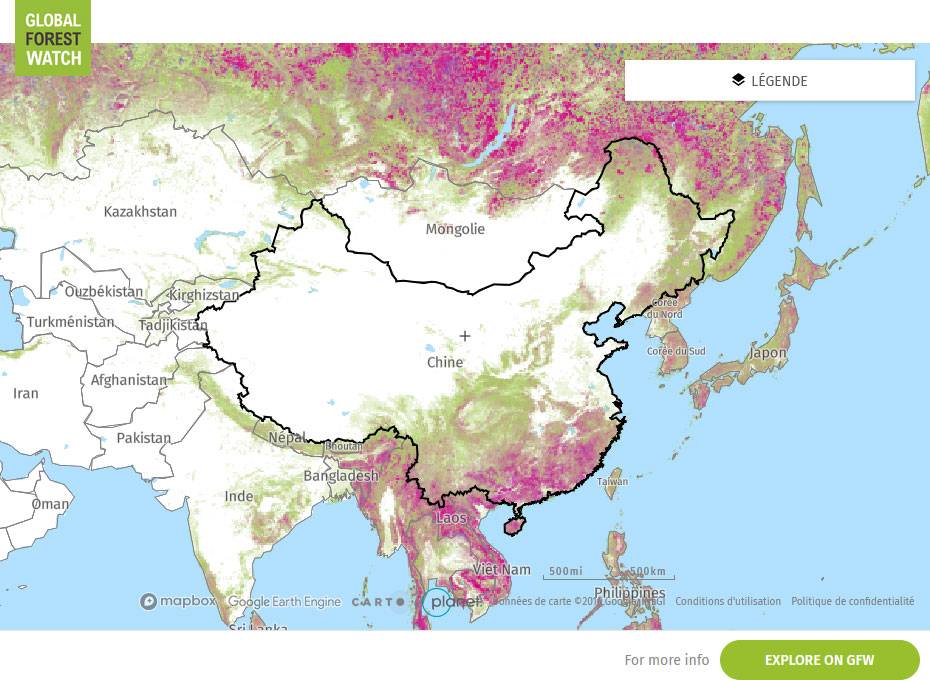
全球森林观察地图
|
CORRUPTION PERCEPTION INDEX (Transparency international) Corruption Perception Index 43/100
0 is highly corrupt, 100 is very clean. |
ILLEGAL DEFORESTATION AND ASSOCIATED TRADE (IDAT) Risk (Forest Trend)
23.70/100
100 is higher risk, 0 is lower risk
|
|
SOURCING HUB RISK SCORE (Preferred by nature) 77/100 0 is higher risk, 100 is lower risk
|
COUNTRY DEFORESTESTATION CLASSIFICATION LIST - EUDR (European Commission) LOW risk category For more information about the methodology, see here
|
Interpretation of Risk Indicators
China-Specific and regional Risk Approach
The risk profile of China's timber supply chains is primarily influenced by four key factors.
Forest classification plays an important role in determining the legal conditions under which timber can be harvested. Chinese forests are divided into ecological public welfare forests and commercial forests, each subject to different management objectives and harvesting restrictions.
Harvesting authorisations are another essential consideration. Assessing the legality of timber harvesting requires verifying the existence and validity of the relevant Forest Harvest Permit, compliance with applicable harvesting quotas and the completeness of supporting approval documentation.
Local governance and enforcement practices can also influence compliance risks. The effectiveness of forestry supervision may vary depending on the resources and capacity of local forestry and grassland authorities, the frequency of forest patrols and the implementation of monitoring and record-keeping systems.
Imported timber represents an additional source of risk that must be considered. China is a major importer of timber and wood products, sourcing raw materials and semi-finished products from numerous countries. Consequently, risks associated with illegal logging, deforestation and forest conversion in countries of origin may be transmitted through China's timber supply chains. Assessments must therefore consider not only domestic harvesting conditions but also the origin, legality and traceability of imported timber.
Risk Interpretation by Forest Category
I. Ecological Public Welfare Forests
Ecological public welfare forests are subject to a strict regulatory framework under China's Forest Law and the Natural Forest Conservation and Restoration Programme. These forests are primarily managed for ecological protection, and commercial harvesting is generally prohibited or subject to significant restrictions.
Their management is supported by administrative documentation and monitoring systems, including forest tenure registration records, ecological management plans and forest patrol records. These documents, which may be maintained in paper or electronic formats, provide an important basis for verifying forest management practices and compliance with applicable regulations.
Despite these regulatory safeguards, some residual risks remain. These may include isolated cases of irregular harvesting approvals, unlawful encroachment on protected forest areas or excessive harvesting carried out under the guise of authorised forest tending operations. In certain areas, insufficient ecological compensation may also contribute to small-scale illegal harvesting activities.
II. Commercial Forests
China applies a forest classification-based management system under which commercial forests are designated primarily for timber production and other economic uses. Unlike ecological public welfare forests, commercial forests provide a legal framework for commercial timber harvesting, subject to applicable regulatory requirements.
In recent years, the Chinese authorities have progressively simplified certain administrative procedures for harvesting in plantation commercial forests. Nevertheless, harvesting activities generally remain subject to the relevant authorisation requirements, including the possession of a valid Forest Harvest Permit where applicable.
Compliance risks therefore persist, particularly where harvesting takes place without the required authorisation, exceeds permitted volumes or extends beyond the approved harvesting area. Verification of harvesting documentation and consistency between authorised and actual harvesting activities remains essential.
Supply Chain Traceability and Residual Risks
Official harvesting permits and other administrative approval documents are important elements of legality verification, but they are not sufficient on their own to establish the legal origin of timber.
A robust risk assessment should therefore be supported by consistent, cross-verifiable documentation covering the different stages of the supply chain, from harvesting and intermediate trading to processing and final sale. This includes checking the consistency of information relating to timber origin, species, harvested volumes, transport and commercial transactions.
For domestically sourced timber, residual risks may arise from forged or inaccurate harvesting permits, as well as discrepancies between declared harvesting locations, authorised volumes and actual harvesting activities.
For imported timber, additional risks may originate in the countries where the wood was initially harvested. These include illegal logging, deforestation and forest conversion, particularly where regulatory enforcement or traceability systems are insufficient. Such risks may persist even when timber is subsequently processed or traded through China.
Consequently, the assessment of timber originating from or traded through China should combine verification of domestic regulatory compliance with due diligence on imported raw materials and semi-finished products. Particular attention should be paid to the original country of harvest and the availability of reliable, verifiable supply chain information.
References
-
FAO, Global Forest Resources Assessment 2025 – China Country Report.
-
FAO, forest land structure and land-use classification standards; China's forest classification (public welfare/commercial; natural/plantation).
-
Preferred by Nature, China Timber Legality Risk Assessment Report, 2021.
-
NFGA, Annual Forestry Administrative Law Enforcement Statistical Reports, 2020–2025; Domestic Timber Legality Verification Guidelines.
-
Forest Law of the People's Republic of China; Regulations on the Administration of Forest Harvest Permits.
-
Chinese Academy of Forestry, Domestic Timber Supply Chain Compliance Traceability Study, 2025.